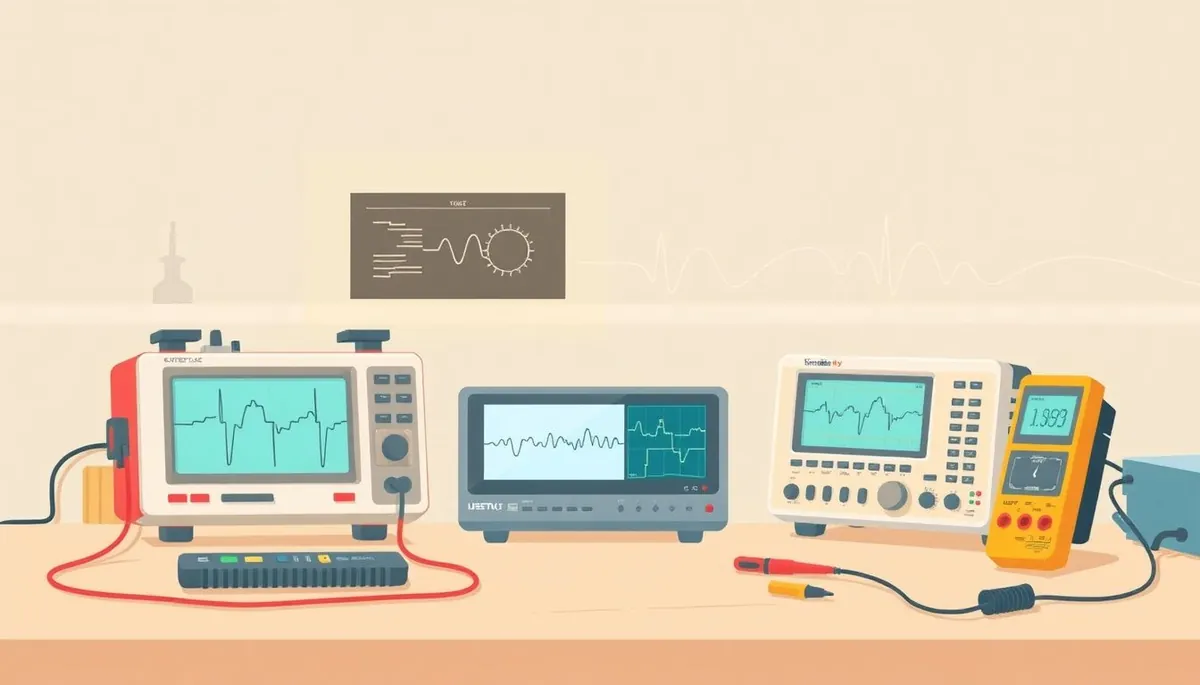
Handheld Scopes vs Bench Scopes: Real-World Verdict
If you’re a hobbyist, electronics technician, or kit builder trying to decide between a handheld oscilloscope and a benchtop model, you’ve probably faced the dilemma: which scope suits your actual workflow, tool budget, and accuracy needs better? The choice impacts your daily troubleshooting, measurements precision, portability, and even how often you replace worn parts like soldering tips or probe accessories. This article unpacks the practical differences between handheld and bench oscilloscopes, focusing on precision, bandwidth-for-price, usability, and real-world scenarios to help you pick the right tool for your bench—or your backpack.
What Are Handheld and Bench Oscilloscopes?
Phone cases · Sponsored
Phone Cases For All — 50,000+ designs. 15% off code FIRST15ALL
Handheld Oscilloscopes
Handheld oscilloscopes are compact, battery-powered devices designed for portability and ease of use in fieldwork. They typically feature smaller screens, touchscreen interfaces, and often integrate multimeters or additional measurement functions. Their portability enables quick diagnostics in cramped or remote locations, like on-site repairs or field installations. However, their physical size often means smaller internal components, impacting measurement bandwidth and sample rate.
Bench Oscilloscopes
Bench oscilloscopes are larger, stationary devices designed for use on a workbench. They usually come with larger displays, more input channels, higher bandwidth, and extensive triggering and analysis capabilities. Performance is often superior to handheld scopes at the same price point, due to their size and power constraints. Bench scopes are the go-to instruments for detailed circuit analysis, protocol decoding, and when consistently high precision is needed.
How Do They Compare in Core Performance Areas?
| Feature / Specification | Handheld Oscilloscope | Bench Oscilloscope | Real-World Impact |
|---|---|---|---|
| Bandwidth | Typically 50 MHz to 200 MHz | From 100 MHz up to several GHz | Bench scopes offer more detailed signal capture for high-speed signals; handhelds suffice for signals below 100 MHz. |
| Sample Rate | Lower sample rates (up to a few hundred MS/s) | Higher sample rates (GS/s range) | Higher sample rates allow bench scopes to reveal subtle timing issues missed by handhelds. |
| Screen Size & Resolution | Small, low-res touchscreen | Large, high-res TFT/LCD | Larger displays improve waveform visibility and make accurate cursor measurements easier. |
| Portability | Battery-powered, lightweight | Requires mains power, heavy | Handhelds excel on the go or cramped spaces; bench scopes stay put and demand dedicated bench space. |
| Input Channels | Usually 1-2 channels | Often 2-4 channels | More channels on bench scopes support complex multi-signal debugging. |
| Triggering & Analysis | Basic triggering modes | Advanced triggering, protocol decode | Bench scopes provide deeper insight into complex protocols and non-repetitive events. |
| Battery Life | Few hours (field use) | N/A (mains-powered) | Handhelds can last a typical repair shift; bench scopes run continuously on mains. |
| Price | More affordable for entry-level use | More expensive, but better specs | Handheld scopes are budget-friendly; bench scopes offer better performance for the price. |
| Durability & Maintenance | Ruggedized for fieldwork, fewer replaceable parts | Sensitive lab equipment, modular maintenance | Handhelds tolerate rough use better; bench scopes typically require more careful handling and maintenance. |
When to Use Handheld Scopes
Phone cases · Sponsored
Phone Cases For All — 50,000+ designs. 15% off code FIRST15ALL
- Field Service and On-Site Repairs: When you need to measure signals in locations without easy access to power, or in tight physical spaces where a bench scope won’t fit.
- Quick Checks and Basic Troubleshooting: Handheld scopes are excellent for instant amplitude/timing checks, signal verification, and measuring in-situ without moving your device.
- Educational Use & Beginner Hobbyists: Their affordability and simplicity make handheld scopes good starter tools.
- Integration with Other Portable Tools: Many handheld scopes combine multimeter functions or logic analyzer capability, saving both time and hardware costs.
When to Use Bench Scopes
- R&D and Development Work: When working on high-speed digital circuits, complex analog systems, or timing-sensitive applications that demand bandwidth above 100 MHz.
- Detailed Signal Analysis: For waveform math, protocol decoding (e.g., UART, SPI, I2C), and deep trigger options, bench scopes offer significantly better options.
- Stationary Lab Environments: When workspace and consistent power are not limitations, and the focus is on precision and reliability.
- Educational Labs and Bootcamps: Bench scopes with comprehensive documentation, large displays, and multiple channels support better learning around complex signals.
Common Pitfalls with Both Types
Phone cases · Sponsored
Phone Cases For All — 50,000+ designs. 15% off code FIRST15ALL
- Overlooking Bandwidth Needs: Many beginners pick a handheld scope based on price or portability but find it does not capture their board’s high-speed signals accurately. Conversely, bench scopes may be overkill for basic 5-10 MHz analog signals.
- Not Considering Probe Quality and Maintenance: Oscilloscope accuracy relies heavily on quality probes and probe tip condition. Cheaper probes or worn tips on any scope type degrade signal fidelity.
- Ignoring Usability and Display Size: Small handheld screens can cause eye strain or misinterpretation of waveforms, confusing beginners or slowing down troubleshooting.
- Battery or Power Management: Handheld scopes may run out mid-job without spare batteries or charging plan, leading to delays.
- Neglecting Firmware Updates and Software Tools: Many scopes rely heavily on software for advanced analysis; failing to update firmware or use companion software sacrifices functionality.
Practical Buying Advice
- Match the scope’s bandwidth to your highest expected signal frequency. For example, if you mainly work on audio circuits or low-frequency analog signals, a 50 MHz handheld could be just fine.
- Consider total cost of ownership: Does your handheld support brand-name or third-party cartridge replacements for probes? What about tip lifespan for integrated soldering irons you might use alongside your oscilloscope?
- Check how the user interface fits your workflow—some handheld models offer simple menus and streaming USB output; others have steep learning curves.
- Look for a scope with a stable sample rate and effective triggering modes; some handhelds compromise these features to keep size down.
- Decide if portability is critical—if you mostly work at a fixed bench, don’t sacrifice accuracy for size.
Summary Comparison Table: Use-Cases, Features, and Limitations
| Criteria | Handheld Oscilloscope | Bench Oscilloscope |
|---|---|---|
| Mobility | Excellent; pocket-sized and battery-powered | Poor; heavy, mains-dependent |
| Measurement Speed | Adequate for under 100 MHz bandwidth | Superior; ideal for >100 MHz and GHz signals |
| Channel Count | 1-2 | 2-4+ channels |
| Screen Size | Small, generally ~3-5 inches | Large, 7+ inches, high resolution |
| Triggering | Basic edges, simple triggers | Comprehensive: pulse width, video, logic, protocol |
| Battery Life | Hours depending on model | Requires mains; no battery |
| Cost | Affordable entry-level prices | More expensive; mid to high-end pricing |
| Durability | Ruggedized for field use | Lab environment, sensitive equipment |
| Best For | Field service, quick troubleshooting, beginners | Development, in-depth diagnostics, labs |
Frequently Asked Questions
Q: Can handheld scopes replace my bench oscilloscope?
A: For simple, low-frequency signals and fieldwork, they can be adequate. However, for high-speed, multi-channel debugging and detailed waveform analysis, bench scopes remain superior.
Q: How important is bandwidth in choosing between handheld and bench scopes?
A: It’s crucial. Insufficient bandwidth means missing or distorting signals—bench scopes tend to offer much higher bandwidth at comparable prices.
Q: Do handheld scopes support protocol decoding and math functions?
A: Some advanced handheld models offer basic protocol decoding and math, but bench scopes generally provide deeper and more reliable analysis features.
Choosing the right oscilloscope depends heavily on your specific use case, expected signal types, workspace, and budget. Handheld scopes excel in portability and ease of use, while bench scopes bring higher precision and extensive features necessary for complex tasks. Understanding these trade-offs will prevent overspending on unneeded features or underperforming tools in your electronics toolkit.
Our picks worth a closer look
- Dawn Ultra Dish Soap, Original Scent, 75 fl oz (2-Pack)Check on Amazon → — see current price and specs.
- Scott 1000 Sheets Per Roll Toilet Paper, 36 RollsCheck on Amazon → — see current price and specs.
- Amazon Basics AA Performance Alkaline Batteries, 48-CountCheck on Amazon → — see current price and specs.
- Tide PODS Laundry Detergent Soap Pods, Original Scent, 112 CountCheck on Amazon → — see current price and specs.
- FNIRSI DSO-TC3 Handheld Digital Oscilloscope and Component TesterCheck on Amazon → — see current price and specs.
