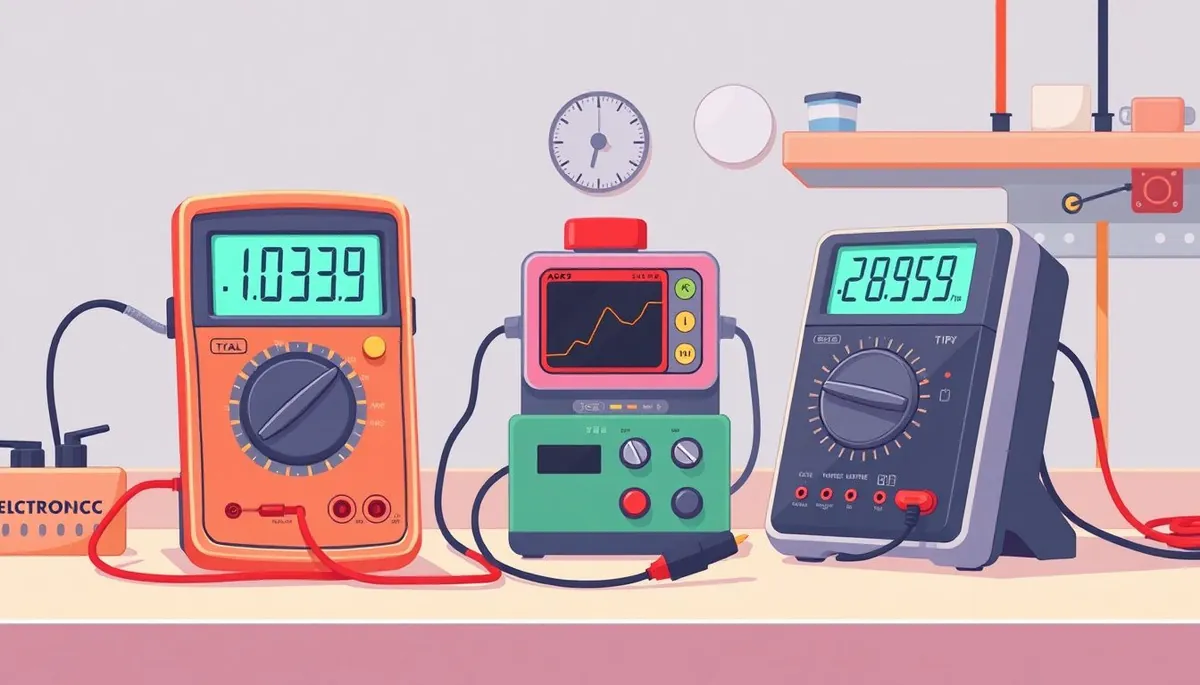
If you’re setting up your electronics bench or upgrading your test gear, you’ve probably wondered: should you get a bench multimeter or a handheld model? Each type has clear strengths and weaknesses, and picking the wrong one can slow your workflow or cost you extra when you really need precision. This article breaks down the practical differences between bench and handheld multimeters, helping you match the right tool to your real needs—whether you’re a hobbyist, kit builder, or bench technician.
What Is a Bench Multimeter vs. a Handheld Multimeter?
Phone cases · Sponsored
Phone Cases For All — 50,000+ designs. 15% off code FIRST15ALL
Bench Multimeter
A bench multimeter is a larger, stationary instrument designed primarily for use on a workbench or in a lab setup. It usually features more precise measurement capabilities, a stable power supply, a wider range of functions, and enhanced connectivity options. These meters are powered by AC mains and offer higher input impedance, better resolution, and often include features like high accuracy voltage and current measurements, temperature, and frequency.
Handheld Multimeter
A handheld multimeter is portable, battery-powered, and optimized for field use, quick diagnostics, and simple troubleshooting. They are compact, rugged, and typically include only the most essential functions to keep the price and complexity down. Though handheld meters are incredibly convenient on the move, they usually come with fewer advanced features and lower measurement accuracy compared to bench units.
See also: 18. Handheld scopes vs bench scopes: real-world verdict
How Do They Differ in Practice?
| Feature | Bench Multimeter | Handheld Multimeter |
|---|---|---|
| Accuracy & Precision | High accuracy, typically 0.01% to 0.1% | Moderate accuracy, around 0.5% to 1% |
| Measurement Range | Wide range, including mV to kV, mA to A | Medium range, focused on practical ranges |
| Functions | Advanced, often includes temperature, frequency, duty cycle | Basic: voltage, current, resistance, continuity |
| Display | Large, high resolution, often graphical or dual display | Smaller LCD, less resolution or backlight |
| Power Supply | AC mains powered (stable for long term testing) | Battery powered, portable |
| Connectivity | USB, RS232, GPIB, LAN, Bluetooth for data logging | Limited or none (some USB/Bluetooth in higher-end models) |
| Durability | Sensitive, not designed for rough environments | Rugged, drop-resistant, weather-proof options |
| Size & Portability | Large, intended for fixed bench setup | Small, pocket-friendly |
| Price | Higher price, often $500-$2000+ depending on specs | Budget-friendly, often $20-$200 |
| Typical Users | Lab technicians, R&D, calibration services | Field technicians, electricians, hobbyists |
When to Use a Bench Multimeter
Phone cases · Sponsored
Phone Cases For All — 50,000+ designs. 15% off code FIRST15ALL
- Precision Testing and Calibration: If you’re performing detailed circuit validation, calibration, or R&D testing, the higher resolution and accuracy of bench meters is essential.
- Long Duration Monitoring: Bench meters can stay powered for long periods without interruptions and offer stable thermal behavior.
- Data Logging and Automation: You’ll benefit from connectivity options that facilitate data capture for analysis on PCs or integration into automated test setups.
- Wide Measurement Needs: If your work requires special measurements like frequency, temperature, or very low currents that need accuracy, bench meters win.
For example, if you’re troubleshooting a power supply ripple or validating a sensitive analog sensor’s output, the tighter specifications of bench meters will show subtle variations your handheld might miss.
When to Use a Handheld Multimeter
- Portability & Convenience: When you need to troubleshoot multiple devices or systems in different locations, a handheld meter is indispensable.
- Rough Environments: Field service work often requires gear that survives drops, dust, and moisture.
- Basic Measurements: Voltage, current, and resistance checks during installation, repair, or quick inspections are perfectly suited to a handheld.
- Budget-conscious Applications: Handheld meters often give you all the essential functionality without breaking the bank.
A typical use case might be diagnosing wiring faults in a control panel, verifying battery voltages on a drone, or testing repair patches on a DIY kit board.
Common Pitfalls and How to Avoid Them
Phone cases · Sponsored
Phone Cases For All — 50,000+ designs. 15% off code FIRST15ALL
- Using a Handheld Meter for Precision Work: Expecting high accuracy from handheld meters will lead to conflicting results and frustration—bench meters are designed for this.
- Relying on Bench Meters in Field Conditions: Taking a bench meter on-site without protection can result in damage or inconvenient setup time.
- Ignoring Calibration Needs: Both meter types degrade over time. Regular calibration is critical for bench meters, and to a lesser extent for handheld meters where precision matters.
- Overbuying Features You Don’t Need: Futuristic display tech, excessive functions, or connectivity options that get little use can add complexity and cost unnecessarily.
Choosing Between Bench and Handheld: What Matters Most?
- Accuracy Requirements: For better than 0.1% accuracy in voltage/current measurement, go bench.
- Mobility Needs: If you need portability and quick checks, handheld is better.
- Budget: Handheld meters start cheaper but keep total cost of ownership in mind.
- Feature Set: Identify must-have functions like temperature, frequency, or logging before deciding.
- Workflow: If you do long-term, repetitive tests, bench meters save hassle; for quick diagnostics, handheld wins.
Quick Side-By-Side Comparison Summary
| Scenario | Best Choice | Reason |
|---|---|---|
| Calibration and lab measurement | Bench Multimeter | Precision, connectivity, stable power |
| Field service and on-site testing | Handheld Multimeter | Portability and ruggedness |
| Educational kits and hobby projects | Handheld Multimeter | Cost-effective and easy to use |
| Complex R&D development | Bench Multimeter | Advanced features and data-logging |
| Electrical installation troubleshooting | Handheld Multimeter | Fast and practical |
Frequently Asked Questions
Q: Can I calibrate a handheld meter myself?
A: Basic handheld meters may allow minor zero adjustments, but professional calibration typically requires sending them to a certified lab. Bench meters almost always need professional recalibration to maintain accuracy.
Q: Are bench meters usable without a computer?
A: Yes, bench multimeters have user-friendly front panels and can operate standalone, but their added connectivity means you can integrate them with software if desired.
Q: How long do soldering iron tips last when using multimeters for testing?
A: This question is more about the iron than the meter: soldering iron tip life depends mainly on maintenance, temperature control, and tip cleanliness. Using a multimeter for basic continuity or voltage checks won’t affect soldering tips at all.
Choosing the right multimeter comes down to balancing accuracy, portability, budget, and your workflow needs. For hobbyists and field techs, a solid handheld meter covers most needs reliably. For lab-level precision, long-term testing, or automation, bench meters provide unmatched performance. By identifying your priorities, you can avoid unnecessary expense or operational headaches and get exactly the tool your bench demands.
Our picks worth a closer look
- Dawn Ultra Dish Soap, Original Scent, 75 fl oz (2-Pack)Check on Amazon → — see current price and specs.
- Scott 1000 Sheets Per Roll Toilet Paper, 36 RollsCheck on Amazon → — see current price and specs.
- Amazon Basics AA Performance Alkaline Batteries, 48-CountCheck on Amazon → — see current price and specs.
- Tide PODS Laundry Detergent Soap Pods, Original Scent, 112 CountCheck on Amazon → — see current price and specs.
- FNIRSI DSO-TC3 Handheld Digital Oscilloscope and Component TesterCheck on Amazon → — see current price and specs.
