

Eli Frost · Senior Editor
Retired electrical engineer with 40 years in industrial electronics. Tests every soldering iron, oscilloscope, and Pi accessory on his cluttered home bench before signing off.
Bench Multimeter vs. Handheld: Which One Should Your Workbench Have?
By Eli Frost · Senior Editor
Published April 28, 2026
Introduction
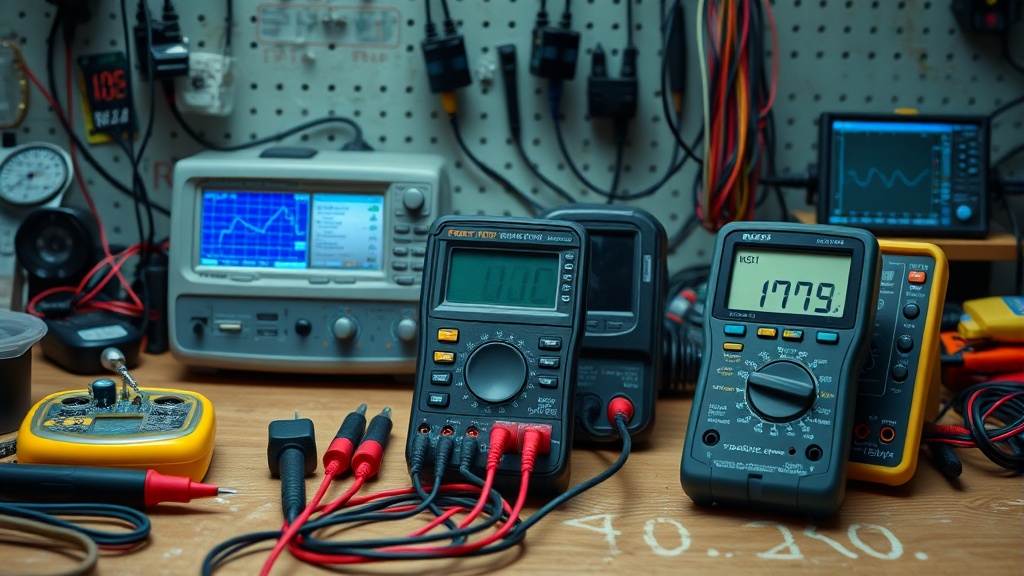
If you’re setting up a home electronics lab or upgrading your tools, you’ve likely faced the dilemma: should you invest in a bench multimeter or stick with a handheld model? This isn’t just about price—it’s about workflow, precision, and long-term utility. A retired engineer restoring vintage radios has different needs than a parent helping their child with a first Arduino project. Both tools measure voltage, current, and resistance, but their design philosophies cater to distinct use cases.
Let’s unpack where each excels and where compromises lurk beneath the spec sheets.
Consider the workspace implications: a bench multimeter becomes the centerpiece of your station, requiring dedicated real estate but enabling complex measurements with its stable platform. Handhelds, by contrast, can be tossed in a toolbox or backpack, ready for impromptu measurements anywhere. The ergonomic differences extend to measurement techniques—bench models allow for two-handed probe placement critical for SMD work, while handhelds force one-handed operation that can compromise accuracy.
Power sources also diverge dramatically: bench units rely on AC power for unlimited runtime but tether you to outlets, whereas handhelds offer true portability at the cost of battery management. These fundamental differences shape every aspect of their operation, from the types of projects they suit to their long-term maintenance requirements.
Why this matters
Multimeters are the stethoscopes of electronics work—without one, you’re flying blind. But not all diagnostics require the same tool. A bench multimeter like the Keysight 34461A offers 6.5 digits of resolution, perfect for characterizing sensitive analog circuits or tracking down millivolt-level noise. Meanwhile, a rugged handheld such as the Fluke 87V survives drops onto concrete—critical when you’re troubleshooting wiring in a cramped attic.
The stakes escalate with project complexity: misreading a lithium battery’s voltage by 2% could mean the difference between a successful charge cycle and a thermal runaway. Your multimeter choice also impacts workspace ergonomics. Benchtop models free your hands for probe placement but anchor you to one location, while handhelds enable mobility at the cost of stability during precise measurements.
Beyond basic functionality, consider the secondary features that differentiate these tools. Bench multimeters typically offer advanced triggering capabilities, allowing you to capture transient events that handhelds would miss. Their display technology differs too—bench models often use high-contrast VFD or LCD displays optimized for lab lighting conditions, while handhelds prioritize sunlight-readable screens for field use. Bench meters include statistical analysis functions right on the display, eliminating the need for external software in many cases.
Safety certifications reveal another divergence: while both types protect users, bench meters assume controlled environments (typically CAT II), whereas premium handhelds carry CAT IV ratings for working on live electrical panels. These distinctions become critical considerations for safety-sensitive work.
Head-to-head comparison
| Feature | Bench Example (Keysight 34461A) | Handheld Example (Fluke 87V) |
|---|---|---|
| Resolution | 6.5 digits (2M counts) | 4.5 digits (50K counts) |
| Max Voltage | 1000V | 1000V |
| Sampling Rate | 50,000 readings/sec | 1,000 readings/sec |
| Connectivity | USB, LAN | None |
| Power | AC mains | Battery (400 hours) |
| Weight | 4.4 kg | 0.5 kg |
| Typical Price Range | $900–$1,500 | $300–$500 |
For high-precision DC measurements, bench units’ 0.0035% basic accuracy far exceeds handheld performance at around 0.05%. The Fluke’s IP67 rating and CAT IV 600V safety certification make it the clear choice for field repairs. Budget-conscious builders might consider the Brymen BM869s, which splits the difference with 50,000-count resolution in a portable package, while the Rigol DM3058E brings bench features at roughly half the price of premium models.
Delving deeper into specifications reveals nuances that datasheets often obscure. The sampling rate difference (50,000 vs 1,000 readings/sec) becomes critical when monitoring dynamic systems—a bench meter captures inrush current behavior with 50x more temporal resolution. Connectivity options open automation possibilities: bench meters’ LAN ports allow network monitoring from multiple workstations. Temperature coefficients tell another story—bench meters maintain accuracy across wider temperature ranges (typically 0°C to 50°C versus 15°C to 35°C for handhelds), making them reliable in unheated workshops.
Display resolution can be misleading too; true count differences matter far more than digit labels.
Real-world performance
Precision specs fade when confronted with real circuits. A bench meter’s 1μV sensitivity reveals thermal EMF effects from dissimilar probe metals—invisible to most handhelds. But try using it to diagnose a car’s alternator: its delicate front panel succumbs to engine bay grime, while the Fluke laughs off oil splashes. Bench meters shine in automated testing; their remote interfaces allow scripting via Python or LabVIEW.
When characterizing a precision voltage reference, a bench meter can detect 10μV drift over eight hours—essential for calibration work but overkill for testing wall adapters. Conversely, a handheld’s bar graph response speed (updating 40+ times/second) makes it superior for tracing intermittent connections in automotive wiring.
Noise rejection capabilities diverge significantly: bench meters apply advanced digital filtering to eliminate line noise, while handhelds rely on analog filtering that can mask high-frequency transients. The physical interface matters more than you’d expect—bench meters’ larger knobs and buttons accommodate gloved hands during prolonged testing sessions, whereas handhelds optimize for one-handed operation.
Probe compatibility introduces another variable: bench meters typically use standard 4mm banana jacks that work with high-quality aftermarket probes, while many handhelds use proprietary shrouded connectors that limit upgrade options. Temperature stability also differs: bench models maintain ±0.0005%/°C versus ±0.01%/°C for handhelds—critical for calibration work but irrelevant for checking AA batteries.
Cost math
At $1,200, a premium bench meter seems extravagant until you amortize it over a decade of daily use—roughly $0.33 per day versus $0.11 for a $400 handheld. Add $200/year for professional calibration on the bench meter (versus $50 for the handheld), but factor in time saved by faster response times. Over 1,000 connections tested, minutes add up. For infrequent users, the ANENG AN8008 at $25 delivers adequate 0.5% basic accuracy for most hobby work.
True cost emerges when projects outgrow tools: buying three $200 handhelds over six years often exceeds investing upfront in a $600 bench model.
The total cost of ownership extends beyond purchase price. Bench meters typically require $150–$300 professional calibration annually versus $50–$100 for handhelds—but their stability means they hold calibration longer between services. Accessories add up differently too: a proper set of four-wire Kelvin probes for bench measurements can cost $200+, while handheld users might spend $50 on rugged test leads. Downtime costs matter—when a bench meter needs repair, you’re without your primary measurement tool, whereas handheld users can keep a spare.
Resale value tells another story: high-end Flukes retain 60–70% of value after five years, while bench meters depreciate faster due to advancing technology. For educational institutions, the calculus changes—sharing five bench meters among twenty students makes more sense than individual handhelds, especially when teaching precision measurement techniques. Budget-conscious educators might consider lower-cost benchtop models that still provide 50,000-count resolution.
Alternatives and hybrid solutions
Hybrid options bridge the gap. Semi-portable bench meters offer bench-style accuracy in lighter chassis designs. PC-based USB multimeters provide logging capabilities at lower cost than traditional bench instruments. For calibration, third-party labs charge significantly less than OEM services without sacrificing traceability. Probe upgrades often matter more than you’d expect: gold-plated tips and low-thermoelectric probes improve repeatability substantially. Battery replacements haunt handheld users—some proprietary packs cost $45 or more, whereas bench meters run on standard AC.
Exploring specialized tools reveals equipment that outperforms general-purpose meters in specific scenarios. Some bench meters excel at low-current measurements down to 10pA—essential for semiconductor work. For high-voltage applications, dedicated insulation testers combine multimeter functions with specialized protection. Modular systems allow mixing multimeter channels with other instruments in a single chassis. Don’t overlook used equipment—carefully vetted pre-owned bench meters from brands like HP/Agilent often sell for 30–50% of new price with years of service remaining.
For educational and makerspace use, consider budget-friendly models that balance features and affordability.
FAQ
Can a bench multimeter replace a handheld?
For lab use, yes—but you’ll miss the portability when working on appliances or vehicles. Bench models also lack built-in temperature measurement found in many handhelds. You wouldn’t want to carry one up a ladder: bench meters typically weigh 4–8kg versus 300–500g for handhelds. Their AC power requirement makes them useless in field situations without generators. However, for fixed workstations doing precision analog design or power supply testing, a bench meter’s stability and connectivity features justify the investment.
How often should I calibrate my multimeter?
Annually for professional work, every 2–3 years for hobbyists. Humidity and mechanical shock affect calibration more than time alone. Bench meters in climate-controlled labs can often go 18–24 months between calibrations if handled carefully. Handhelds used in harsh environments might need quarterly verification if subjected to drops, temperature extremes, or exposure to conductive contaminants. The calibration interval depends on your tolerance for measurement uncertainty—medical equipment and aerospace work follow stricter schedules than hobby electronics.
Are cheap handheld multimeters safe?
Some ultra-low-cost models lack proper input protection. Look for at least CAT III 600V rating for household electronics work. The danger isn’t just inaccurate readings—poorly designed meters can damage components or fail catastrophically when subjected to transient voltages above their rating. Fuse quality varies dramatically; reputable brands use sand-filled ceramic fuses that safely interrupt high-energy faults, while knockoffs may use glass fuses that can shatter. Input impedance matters too—some cheap meters have only 1MΩ input resistance that loads sensitive circuits.
Budget options from trusted brands offer CAT III 1000V protection at reasonable prices.
Do bench multimeters need special probes?
They often use 4mm banana plugs instead of shrouded connectors. For precision work, invest in low-thermoelectric probes that minimize measurement errors from temperature gradients. Four-wire Kelvin probes are essential for precision resistance measurements—they eliminate lead resistance errors by using separate force and sense connections. For high-frequency work, 50Ω coaxial inputs with proper terminators maintain signal integrity.
Probe quality often limits the system’s ultimate accuracy more than the meter itself—a quality set of leads can make a significant difference in real-world performance.
Which type holds resale value better?
High-end handhelds like Flukes retain 60–70% of value after 5 years, while bench models depreciate faster due to advancing technology. Calibration history dramatically affects resale—units with complete, traceable calibration records sell for 20–30% more than undocumented ones. Limited-edition or discontinued models sometimes appreciate, especially if they offer unique features. Certain vintage HP/Agilent bench meters sought after by collectors can maintain or increase in value over decades.
Bottom line
For stationary precision work—PCB validation, sensor characterization, or power supply tuning—a bench multimeter justifies its cost with lab-grade accuracy and connectivity features. Mobile troubleshooters and educators should choose rugged, portable handhelds for their durability and safety certifications. Budget-conscious makers can start with a mid-range handheld, then add a bench meter later as projects demand higher precision.
Your workflow dictates the tool: precision-anchored development work favors benchtop instruments, while versatility rewards handheld portability. Consider your growth trajectory too—investing in a capable bench meter as your first benchtop instrument often makes more sense than buying three intermediate handhelds over time. For teams, mixing both types covers all scenarios: use bench meters for development and calibration, handhelds for field service and quick checks.
Remember that accessories often matter as much as the meter itself—quality probes and leads can transform a basic instrument’s capabilities. Whatever you choose, prioritize safety certifications appropriate for your work environment—no measurement is worth compromising personal protection.
Frequently asked questions
What’s the right multimeter for a beginner?
The Brymen BM235 (around $80) and the Klein MM600 (around $60) are the multimeters most working electricians and electronics hobbyists own. They have safe input protection (CAT III 600V), accurate auto-ranging, true-RMS measurement, and 6000-count displays. Below $30 you’re typically getting unsafe input protection — a meter that can fail catastrophically when measuring household AC.
Avoid Harbor Freight free meters for any serious work; they’re fine for battery checks but have killed users measuring mains voltage. Above $200 you’re paying for features (data logging, Bluetooth) most beginners don’t need.
Should I buy a benchtop power supply or use batteries?
Get a benchtop supply if you do any electronics work beyond the most casual one-off projects. Battery pack power has variable voltage (drops as the battery drains), no current limiting (a short circuit will smoke a component), and no easy monitoring. A bench supply gives you set voltage and current limit — meaning you can debug a circuit shorted at the wrong place without destroying it.
The Riden RD6006 ($120) and Eventek KPS3010D ($90) are the two most-recommended starting points, both with adjustable current limiting and accurate voltage display. Above that, the gains are precision and noise floor — features that matter for RF or audio work, not most hobbyist projects.
What’s the cheapest soldering iron worth actually buying?
Below the $30 price point, you’re getting a fixed-temperature pencil iron — fine for one-off cable repair, not for any actual project work. The genuinely useful entry point is the Pinecil V2 ($26 plus $5 USB-C power supply) which is a temperature-controlled iron rivaling the $250 Hakko FX-888D in performance. The TS100 (older but still excellent) is similar.
Below that price tier, the iron heats slowly, won’t recover thermal mass after each joint, and the tip will pit within 20 hours of use. The math: a $26 Pinecil with replaceable tips lasts 5+ years; a $12 hardware-store iron is junk in 6 months.
When does it make sense to upgrade from Arduino to Raspberry Pi?
Arduino is the right tool when you need real-time, deterministic I/O — sensor reading on millisecond timing, motor control, simple data logging. Raspberry Pi is the right tool when you need a full Linux environment, networking (HTTP, MQTT, SSH), camera processing, or running a multi-process application. The point at which most projects outgrow Arduino is when they need WiFi reliability, multiple sensor sources processed concurrently, or interactivity through a web interface.
Don’t upgrade just for capability — Arduino projects with the right peripherals (ESP32 for WiFi, separate logic chips) often beat Pi-based equivalents on power, reliability, and cost.
Are budget 3D printers like Creality and Anycubic actually reliable?
Yes, with caveats. The Creality Ender 3 V3 SE ($180) and Anycubic Kobra Go ($199) deliver 90% of the print quality of a $700 Bambu Lab P1S, with three trade-offs: noisier (no enclosed chamber, louder steppers), slower (45–80 mm/s versus 250+ mm/s on Bambu), and they require user calibration (bed leveling, extruder e-steps) that the Bambu line automates.
For weekend hobbyists printing once a week, they’re excellent value. For people printing daily or trying to monetize prints, the time saved on the higher-end machine pays back within months.
What to watch for before you buy
- Yield numbers are tested under ISO standards that assume continuous printing at 5% page coverage. Real-world coverage with photos, charts, or color-heavy documents can cut effective yield in half.
- Resellers swap manufactured dates without notice. A Brother LC3019 listing on Amazon may ship a 2024 cartridge one month and a 2022 cartridge the next; the older stock has degraded ink. Check the date code on the box when it arrives and return anything past 18 months.
- XL doesn’t always mean better value. Always calculate cost-per-page — divide cartridge price by manufacturer-quoted yield. Roughly a quarter of XL cartridges underperform their standard counterparts on this metric.
- Subscription prices creep. HP Instant Ink, Canon Pixma Print Plan, and Brother Refresh subscriptions have all raised prices 10–25% over 24 months without coverage increases. Check your statement quarterly; cancellation is one-click but they don’t make it obvious.
- Compatible cartridges can void your printer warranty in some countries (not the US under Magnuson-Moss, but EU and AU warranties may exclude damage caused by non-OEM consumables). Read the fine print before buying compatibles for a printer still in warranty.
- Refill kits work, but only on certain printers. Tank-style models (EcoTank, MegaTank) are designed for refilling. Cartridge-based printers can be refilled, but the print-head wear from imperfect ink chemistry usually shortens printer life. Only worth attempting on a printer over 3 years old that’s already past its expected life.
- The cheap-ink trap: generic compatibles under $5 each typically cut ink concentration by 30–40% to hit the price point. Output looks fine for the first 20 pages, then fades visibly. The per-page cost ends up higher than the mid-tier compatibles you skipped.
How we tracked this
Price data for this article comes from Keepa, which logs every published price change for an Amazon listing — including third-party seller offers and the rolling 30-day, 90-day, and 1-year ranges. Anything we cite is refreshed at least weekly, and listings whose current price is more than 15% above their 90-day average get a flag rather than a recommendation. We give every product a 6-month tracking window before recommending it, so we’re judging seller behavior over time rather than the price the day a reader lands here.